Guindo Design
Strategic Digital Product Design
Help at Hand by O2 Health
Service flow design for a mobile telecare platform
In the early 2010s, the British telecare market was dominated by home systems connected to landlines, limiting the service to users' homes. O2 Health, the digital health division of O2 (Telefónica Group), identified a pioneering opportunity at the time: to take telecare outside the home.
The result was Help at Hand, a pioneering mobile telecare service in the UK. Its proposal combined a portable device (pendant or watch) with mobile connectivity, GPS and fall detection, linked to a 24/7 response center.
The goal was to offer older people or those with chronic conditions more autonomy and independence, and their caregivers peace of mind and constant connection, even when the user was on the move.
The design challenge was to define how this service ecosystem should work: what happened when an emergency was detected, how alerts were notified to each stakeholder involved, and how the traceability of assistance was maintained in real time.
Notification flow design
Our studio was invited to collaborate with the Telefónica R&D team to shape the service and interaction flows of the system.
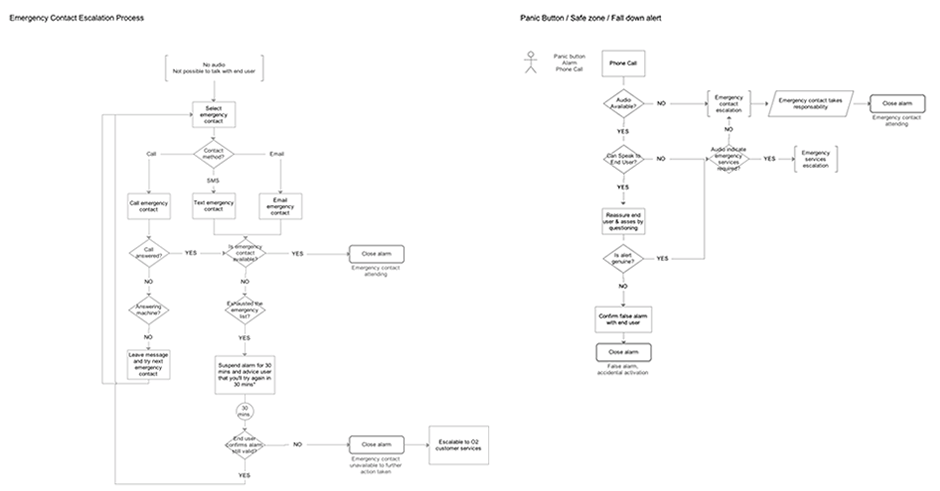
Generic service flows.
Based on previous research documentation, which included user analysis, care processes, caregiver and operator profiles, we were responsible for translating the research findings into a practical and understandable service architecture for the engineering teams.
Our focus was on:
- Defining the complete interaction structure between user, device, monitoring center and caregivers.
- Designing the notification and response flows for critical events (manual activation, automatic fall detection, leaving a "safe zone", connection failure, etc.).
- Visually representing the processes, clarifying roles, times and communication points between actors.
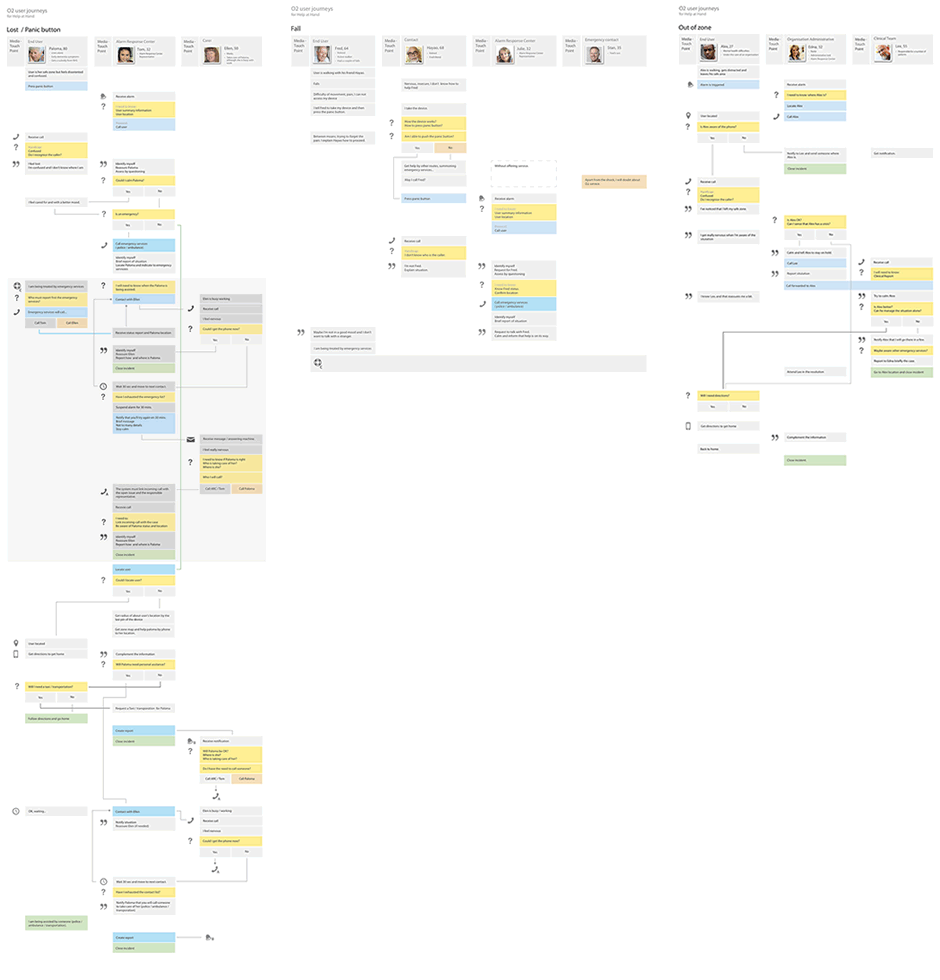
Notification and response flows for critical events.
The difficulty of implementing the service
O2 Health launched Help at Hand in 2012, but the service was withdrawn a year later after lower-than-expected adoption. The causes, publicly identified by O2, included the low penetration of mobile services among the elderly, the complexity of the distributed care model and the difficulty of scaling the service in a regulated environment.
Beyond the commercial result of the product, the project left valuable lessons on how to design for ecosystems where trust, simplicity and coordination are as critical as technology. For our studio, it was an opportunity to apply service design and interaction modeling tools in a context of high sensitivity and social responsibility.