← Blog from Guindo Design, Strategic Digital Product Design
The Mirror Glass Building effect
Early 1920s, Mies van der Rohe Mies van der Rohe burst into the world of modernist architecture with a radical proposal: a all-glass building in Berlin. A minimalist, unadorned monolith, it inaugurated the era of the skyscraper and soon became a symbol of corporate power. The era of the skyscraper was born, the building-symbol of office architecture and large corporations.

Over time, reflective glass established itself as the emblem of large offices. Its technical milestone was the construction of the John Hancock Tower Boston: a pure prism of glass in which the inner structure is barely visible. The building disappears in its own reflection and at the same time dominates its surroundings.
The mirror as a control strategy
The «mirror effect» is a basic element of the architecture and design of the control elements, the observer can observe without the rest of the passers-by noticing where he is looking, he can observe without being observed. Just as a guard with reflective glasses can follow every movement with impunity, the mirror building turns its façade into a mask.
The mirror, moreover, has a double edge. On the one hand, it attracts the narcissism of the naïve who come to groom themselves. On the other, it discomforts those who sense that there is someone watching from the other side. Fascination and rejection on the same surface.
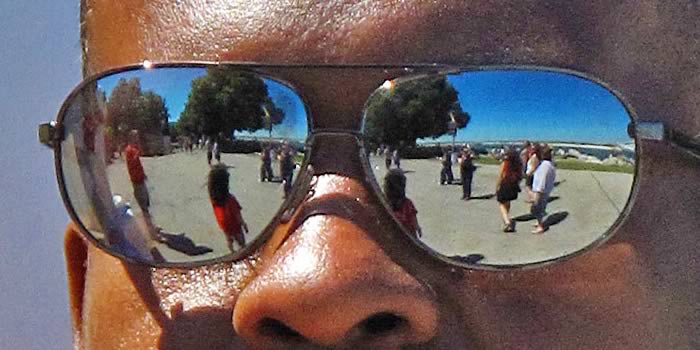
Something similar happens on the Internet. Social widgets, such as Facebook's famous “Like” or Google's now defunct +1 button, work like reflective glass: they show us traces of those who have been there before. Suddenly we see the footprint of a friend who commented, the avatar of someone who shared or the number of users who clicked.

This visibility generates a call effect: who hasn't compulsively glanced at their reflection in a shop window as they pass by? With social widgets, the gesture is repeated in a digital version: we check if someone sees us, if we leave a mark, if we are part of the landscape.
Does it repel users? I'm not entirely sure, maybe at first, but just like the mirror-buildings they are now part of the landscape and we have become accustomed to interacting with them. But how do we interact with them? Clearly compulsively, just like when we walk down the street and glance sideways at our reflection in the shop window.
Like as Oliver Reichenstein rightly put it these are temporary elements, which will tend to disappear sooner or later, such as the use of reflective materials in buildings, whose reflections sometimes dazzle us when the sun is shining brightly.
The mirror, whether glass in a corporate tower or digital in a social network, gives us back an image of ourselves, but rarely lets us see what is behind it. And perhaps therein lies the danger: in mistaking the reflection for the real experience.