← Blog from Guindo Design, Strategic Digital Product Design
StepAlong: the new way to create and follow product tutorials and instructions
Following instructions, whether for cooking a recipe, assembling a piece of furniture or repairing a mechanism, is usually quite a cumbersome activity. If you use a recipe book or manual, jumping from page to page with your little finger, or assimilating instructions with food on the stove can be stressful. Let alone digital formats, continually trying to start, stop, rewind and rewatch a YouTube, Instagram or TikTok video while on task with your hands full can be a very frustrating experience.
I can already find it on YouTube
There is a widespread perception that social media and YouTube are the easy answer when it comes to finding tutorials. But...
About ten years ago, Facebook, YouTube, Twitter and others began using algorithms to maximise users' attention, changing their business models so that algorithms could drive people's attention in a cost-effective way. They wanted people to spend more time on their platforms, and therefore watching ads, so they developed algorithms to predict what content would keep people engaged, suggesting new videos or playing them automatically. These algorithms adjusted according to users' preferences, offering more of the same if they kept interacting.
At least that was the idea. The problem is that people, as irrational and emotional beings, tend to be more “interested” in shocking, alarming or disturbing content. Therefore, if the algorithm shows a video that produces an emotional reaction in us (simply a surprised face to illustrate the cover of a tutorial), it is likely to grab our attention and make us want to watch it, thus encouraging the algorithm to show more of the same (more “wait for the end...”), and more, and more, and more, and more of the same. So gradually and inexorably, a perfectly normal person looking for a tutorial on how to fix a plug socket ends up wasting the afternoon watching “funny” videos of people getting electrocuted.
When there is a major flood in a large area, paradoxically the first resource that becomes scarce is drinking water. On the internet, for many years now, we have been in a quagmire, saturated with content that brings us nothing and noise. Reliable sources of information are not scarce, they are almost impossible to locate.
Shake before use
With all these things in mind we created StepAlong. The idea for StepAlong came during the pandemic. Tim bought a Instant Pot y Dimitry a Thermomix, Both devices had very well constructed and easy-to-follow instructions, which put a lot of focus on each task and step. We wondered if this standardised experience could not be applied to any environment, for example, in order to provide a solution and an ecosystem around the experience of following instructions.
There are many web applications that create automated tutorials for software, using screenshots and videos, but there are hardly any solutions for real-life physical products or tasks. Most of them are linked to the software used by industrial designers to create products, require a lot of technical knowledge or are customised solutions that are not very affordable. There are also many specific solutions for creating reels, which are fine for creating marketing pieces and inspiring users, but not the best user-facing solution to follow a task.
Tim Towle, Dimitry Lvovsky y we We founded StepAlong as an end-user oriented solution for businesses and professionals, so that they can have more control over the experience their customers have when installing, using or repairing their products.
Cut along the dotted line
A StepAlong is a new way of following procedures and instructions, created and designed specifically to improve the experience of following product manuals., with a step-by-step approach that allows the user to complete the task at their own pace on any device.
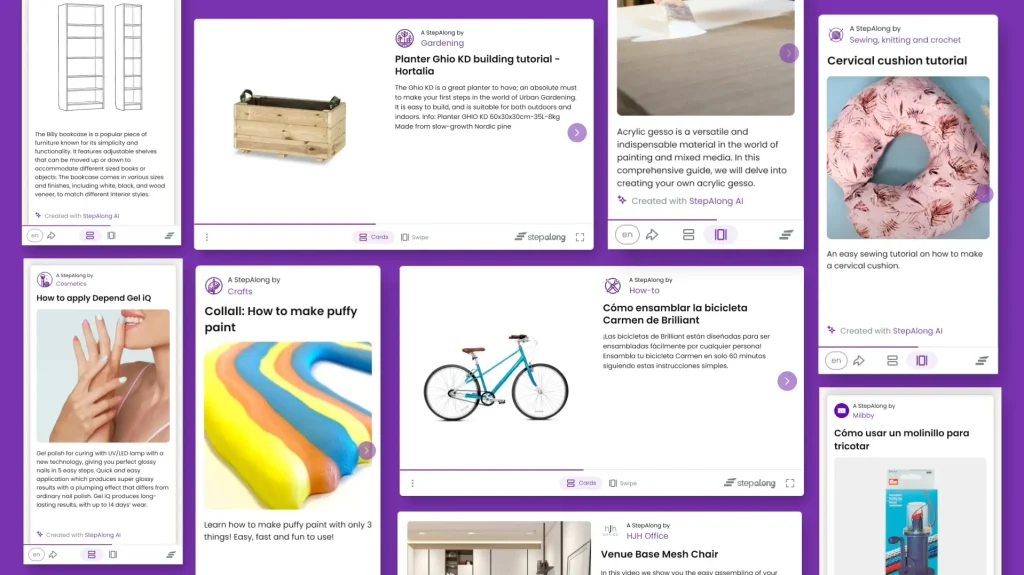
StepAlong is not meant to be a substitute for YouTube and social media, but a complement. Social media algorithms work very well for exploration and discovery, but social media platforms are designed to stay on social media for a long time. StepAlong's goal is for users to use the tool to perform tasks in the real world.
For companies, StepAlong is a perfect tool to gain more control over how users properly install, use or repair their products, offering the possibility to immediately update instructions based on user feedback. It facilitates the creation of instructions by reusing existing material through AI, such as YouTube videos, PDF product manuals or texts, allows the automatic translation into several languages (also with AI) and we are working on many more functionalities: user experience analytics, design customisation, export to other formats...
StepAlong helps companies improve the user experience with their products, by:
- Instructions accessible online and available in printable format.
- Multilingual support, with your instructions available in the language of each market.
- Clear images with text that make assembly easier and more accessible to all customers.
- Pre-purchase visibility, ensuring that online customers can access assembly instructions before they buy.
If product manuals are key for the success of your company, we encourage you to book a demo to show you the platform.