← Blog from Guindo Design, Strategic Digital Product Design
John Dewey: learning, experience and closure
If Pierce was the father of the pragmatic method and James the disseminator of it. Dewey put it into practice, defining education as we know it. If you ever made a model of a plasticine volcano at school in your childhood, or if you used the case method at university, it is thanks to John Dewey.
After graduating from the University of Vermont, John Dewey (1859 - 1952) worked as a teacher, teaching classics, algebra and science. After receiving his doctorate in philosophy from Johns Hopkins University in 1884, he became head of the new department of psychology, philosophy and pedagogy at the University of Chicago.
When he arrived in Chicago, he found himself in a city of half-built skyscrapers, swamped by immigrant workers in the midst of social struggle, where strikes were violently repressed by the state. Dewey soon empathised with them, became involved in social reform and befriended feminist activist Jane Adams. Concerned about working for a university that perpetuated the establishment and deregulated capitalism, he concluded that the country needed different schools.
Learning by doing
His interest in the philosophy of education grew over the years, and he published several books on the subject. To test his theories, he founded in 1896, together with his wife Alice Chipman, the “Laboratory School of the University of Chicago”, a primary and secondary school linked to the university, where greater emphasis was placed on cooperative, active learning, based on experience and practice, abandoning the characteristic rote learning of the 19th century.
The key to the new education was «manual training». Before industrialisation and the exponential growth of cities, children interacted with animals, crops and tools. They were educated by nature «with real things and real materials». Urban children needed instead to sew, cook, and work with metal and wood. However, this new manual training was not to be a mere instrumental education to learn a trade, it was to be scientific and experiential, an introduction to civilisation.
By working in groups to make models and models, children in the laboratory school learned to cooperate, understanding science without textbooks or lectures. Learning by doing replaced learning by listening, and cooperative learning also encouraged a democratic classroom, without elites, ethnic divisions or economic inequality.
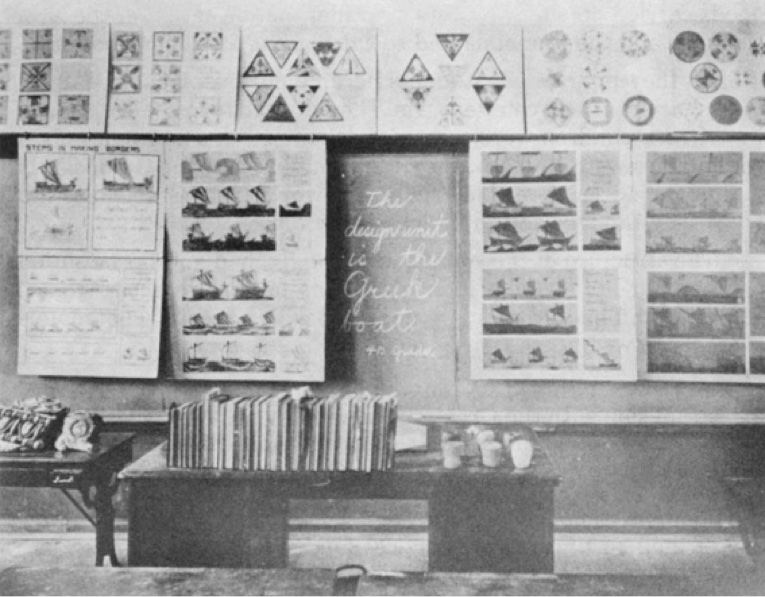
These theories of learning as an interactive and experimental process based on projects have taken almost half a century to take root in the contemporary educational system, being the basis of most schools. This methodology is even more important in the field of design.
However, things did not go smoothly for Dewey with this project. He was branded a communist and radical for his ideas, and after a dispute with the university president, Dewey and Chipman closed the school in 1905 and moved to Columbia University, where he taught until he retired in 1930.
Experiences and situations
In his ideas, Dewey combines the scientific interest of Pierce with the humanistic approach of James, bringing a very open and progressive sensibility. More important than the scientific method itself, for Dewey the most important thing is to apply critical intelligence to people's problems, with the aim of leading a better life. This implies having an open and exploratory attitude, continually revising previous beliefs, using techniques of observation and experimentation, in continuous connection with practical human concerns.
Dewey emphasised the importance of recognising the meaning of human experience as the foundation of the enquiry process. For Dewey, «experience» is a process situated in a natural environment, mediated by socially shared symbols, which actively explores and responds to the ambiguities of the world. Thus, experience is conditioned by our biological structures as well as by the social context. The experience is always physical, mental and social..
Inspired by Darwin's theory of natural selection, he advocated a naturalistic theory of logic, based on the assertion that logic must be derived from our biological structures and functions, as well as from the relationships between organism and environment.
“An organism does not live in an environment; it lives through an environment”.”
Our responses, both mental and physical, are influenced by our cultural environment. The problems to be solved arise from the relationships with others and the meaning we give to the world. The “situation” as the locus of organism-environment interactions.
Confusion as the standard for inquiry
Doubt is preceded by an imbalance in organism-environment interactions, what Dewey called an «indeterminate situation». We feel doubt in a particular situation in which we find insecurity, instability, disturbance, ambiguity, confusion... The situation is not only «open» to investigation, but it is open in the sense that its parts are not united (following James' scheme).
To solve a situation, the first step is to look for the components that make up the situation, or the “facts of the case”, by observation. Since ideas are abstract, their meanings must be embodied in some symbol (and here we return to Pierce). Without symbols there are no ideas; a meaning that has no body cannot be used. We must be able to “see the idea”.
Ideas can become operational as they encourage and direct further activities. Similarly, facts are used to test and develop ideas, and these are only relevant if they interact with each other, if they can provide an answer to a situation. These can be provisional “test facts” in the process of supporting (or not) the idea. The research ends when the original undetermined situation becomes determined, i.e. when it is a closed situation or «universe of experience”.
Dewey had a great sensitivity for Art, and in some ways helped to dignify it as a discipline where ideas are elaborated. He drew attention to the very act of drawing and its process, where ideas emerge and are clarified through interaction with pencil and paper. The activity of defining and forging connections actively produces new insights and knowledge as new elements are combined with existing elements and experiences.
There is no doubt that the process of sketching and prototyping, where the final solution emerges from experimenting with ideas through interaction with physical objects and different types of sensory information, is intrinsic to the practice of design.
Closing the aesthetic experience
For Dewey, experience at its most complete, meaningful and rewarding is aesthetic experience. An experience acquires an aesthetic quality when it «runs its course to completion”. Normally we experience distraction, dispersion and disconnection between what we observe and what we think, what we desire and what we get. When a job is successfully completed and a problem or situation (whether eating, playing a game, having a conversation) is resolved in a way that can be consummated, without interruption or cessation, it is an aesthetic experience.
Therefore, aesthetic experience is not limited to the artist or artistic creation, but is an important and integral part of all intelligent and creative human activity. A mathematical formula or an accomplished sporting action gives us aesthetic pleasure. Thinking satisfies us emotionally because it is an integrated and completed fact in our head. In fact, Dewey's aim with his seminal book “Art as Experience» was to recover the continuity of “aesthetic experience in the normal processes of life”.
Art is particularly interesting for Dewey, as it fosters those moments when the past reinforces the present and the future is perceived more immediately. It is then that we feel alive: we are fully connected to our environment and are not preoccupied with memories of the past or anticipations of the future, i.e., we are not preoccupied with the past, we have an experience.
As with James, for Dewey emotion is also important in aesthetic experience, both as a mediator between the different aspects of experience and as a qualifying component. It is also very important to be an actor in it, when we somehow control its qualities through our action. Aesthetic experience is therefore inherently linked to doing.
Whether it is giving meaning to a piece of art or design, or being an actor in the process of defining a solution gives us satisfaction. Works that are open to interpretation capture us because they require our participation in order to be closed. Sometimes we give meaning to objects, situations and people, for the mere fact of concluding and giving meaning, because if there is something we hate, it is false closures.
Continue reading
This post is the third in a series of four on Pragmatism and Design:
- Charles Sanders Pierce (I)
Practical consequences, abduction and semiotics. - William James (II)
Mediation, body and emotions. - John Dewey (III)
Learning, experience and closure. - George Herbert Mead (IV)
Identity, social relations and objects.
Bibliography
Brag M. Pragmatism. In Our Time. BBC Radio 4.
Dalsgaard, P. (2014). “Pragmatism and design thinking”. International Journal of Design, 8(1), 143-155.
Dewey J. “Art as an Experience”. TarcherPerigee, 2005.
Gibbon, P. “John Dewey: Portrait of a Progressive Thinker.”HUMANITIES, Spring 2019, Volume 40, Number 2
Provenzoi, E. (1979). History as Experiment: The Role of the Laboratory School in the Development of John Dewey's Philosophy of History. The History Teacher, 12(3), 373-382. doi:10.2307/491145
Rylander A. «Pragmatism and Design Research». Ingår i Designfakultetens serie kunskapssammanställningar, utgiven i april 2012.