← Blog from Guindo Design, Strategic Digital Product Design
Muriel Cooper: Pioneer of graphic and digital design
When we talk about pioneers in electronic communication, one of the most overlooked people is Muriel Cooper, perhaps the first graphic designer to apply her skills to the computer screen.
Born in 1925, she graduated from the Massachusetts College of Art in 1947. He discovered computers by accident in 1967 during a summer school course at the MIT, taught by Nicholas Negroponte, while working as a graphic designer for the MIT Office of Publications.
When looking at the data encoded in Fortran on the screen, he exclaimed: “This doesn't make any fucking sense to me!. However, he soon realised the enormous creative potential of the tool and, in 1975, he founded the Visible Language Workshop (VLW) at the MIT Media Lab together with Ron MacNeil, The aim is to encourage students to use graphic design techniques to translate opaque computer data into more understandable representations through text, images and interactive diagrams.
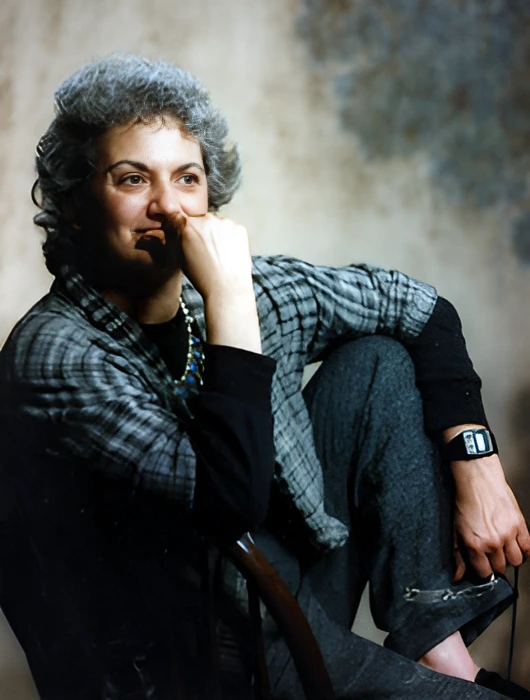
Throughout her career, Cooper was never an expert programmer, but she relied on MacNeil's technical expertise to implement her ideas. Her approach was more like that of an art or design school, where no recipes or formulas were offered, but rather experimentation and creativity. During the 1970s and 1980s, the rapid evolution of computers forced software designers to constantly rethink their design standards, making activity at the VLW intense and dynamic. The Visible Language Workshop was active until his death in 1994, at the age of 68.
Cooper is not only important for his work, but also for his influence on other designers. Through teaching and research, he promoted the idea that computers could have a clear, attractive and understandable visual representation. She opened the door for designers to integrate into environments dominated by programmers, mathematicians and scientists, demonstrating that screens full of cryptic code could be replaced by elegant typography, colour and expressive animations. She was a teacher and inspiration for students such as Lisa Strausfeld (Pentagram) and John Maeda. Instead of dictating what to do, he encouraged them to experiment and inspired them with his irreverence and creativity.
Thanks to the work of pioneers such as Cooper, we have come to understand that when designing user interfaces, it is as important to define how they look as what can be done with them.. Many of today's successful products, such as the Wii, the iPod and the iPhone, would have developed differently without people like Cooper entering the world of interactive design.
Acknowledgements
- In 2023, the Museum of Modern Art (MoMA) in New York acquired the iconic MIT Press colophon, designed by Cooper in 1965. This logo, composed of seven bars representing the lowercase letters «mitp» as abstract books on a shelf, has adorned the spines of every book and magazine published by MIT Press ever since.
- In 2025, the centenary of his birth was celebrated with a series of commemorative events at MIT, highlighting his impact on design and education. During these celebrations, a new edition of the book Muriel Cooper, by David Reinfurt and Robert Wiesenberger, which explores his legacy and contributions to graphic and digital design.
Finally, here are some quotes by Muriel Cooper to reflect on:
- «Information is only useful when it can be understood».»
- «Graphic design is a filtering process».»
- «Electronic is malleable. Print is rigid.»