← Blog from Guindo Design, Strategic Digital Product Design
Daphne Oram, pioneer of electronic music and natural interfaces
London, 1942. Daphne Oram, a talented pianist, organist and composer of only 18 years of age, turns down a position at the Royal College of Music for a job in the BBC as a junior studio engineer and “music equaliser”.
Within a few years of working there, he discovered the advances in synthetic sound. In 1946, the BBC had just acquired tape recorders, which he used occasionally for opera recordings, and he began to experiment with them on his own: he collected all the available tape recorders and dismantled them in a studio, often staying there until the early hours of the morning. He recorded sounds onto the tapes, cut them up and made loops I played with them, lowered and raised the playback speed, played them backwards... When dawn came, I put all the tape recorders back in their places.
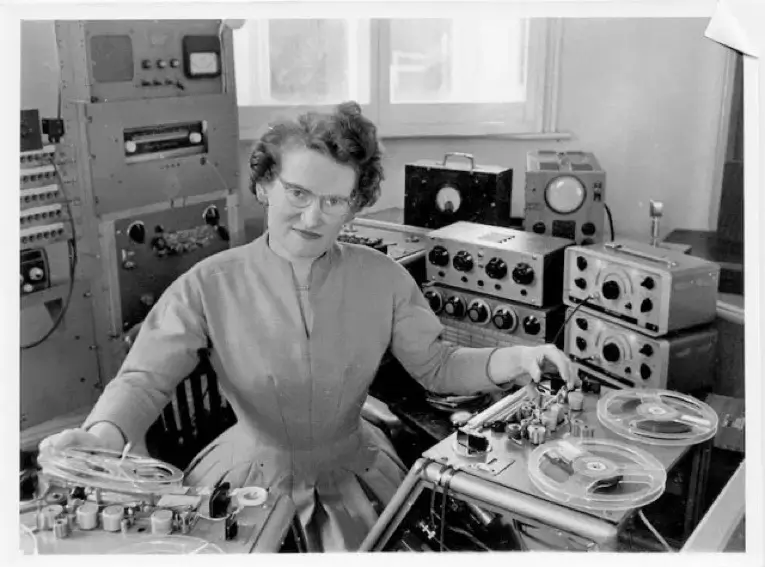
Daphne Oram was a visionary who was clear from the outset about the creative potential of machines:
«Just as the camera and motion picture film have exploited the ideas of time and space to tell stories, surely the microphone and tape could do the same for music».»
While experimenting with these new technologies, he is also dedicated to composing music, creating iconic pieces such as Still Point, the first composition in history to combine classical orchestra and electronic sounds. However, it was never performed live, was rejected by the BBC itself, and remained only as a score for 70 years, until 24 June 2016, when the London Contemporary Orchestra performed Still Point live for the first time.
It did not take long for her to become a studio director, and in 1958 she and her colleague Desmond Briscoe, convinced the BBC to create the Radiophonic Workshop, one of the first studios specialising in sound effects, atmospheres and background music. His work here was seminal, laying the foundation for electronic music creation techniques, and collaborating in the creation of iconic tracks such as the one for the TV series Doctor Who.
But Daphne was going too fast for the times, in every way, and her male colleagues considered her “a very difficult, willful and stubborn person, very bad attributes for a woman”. So in 1959 she left the BBC to set up her own studio-laboratory in a barn in Kent, where she developed her own technique for creating electronic sounds: Oramics.
Oramics is a completely disruptive device even today, like a missing link in electronic music instruments. Daphne had knowledge of optical recording and its use in film projectors, and wanted to control her system by drawing directly on film strips. The Oramics technique consists of drawing waves on 35mm photographic film., These drawings were read by photoelectric cells which in turn generated an electrical charge, thus controlling the frequency, timbre, amplitude and duration of the sound. The machine was monophonic, it could only reproduce one sound at a time, so if you wanted to add variables to the sound, such as pitch or echo, you had to use several tapes in parallel.
The flexibility and control over the nuances of sound was unparalleled in analogue synthesizers of the time. In addition the interface was completely intuitive and natural (NUI), there was a direct relationship between the graphic image and the audio signal, it was enough to play around experimenting with waveforms to create sounds. Daphne had so refined the technique in her head that she could visually imagine the sounds she wanted to reproduce.
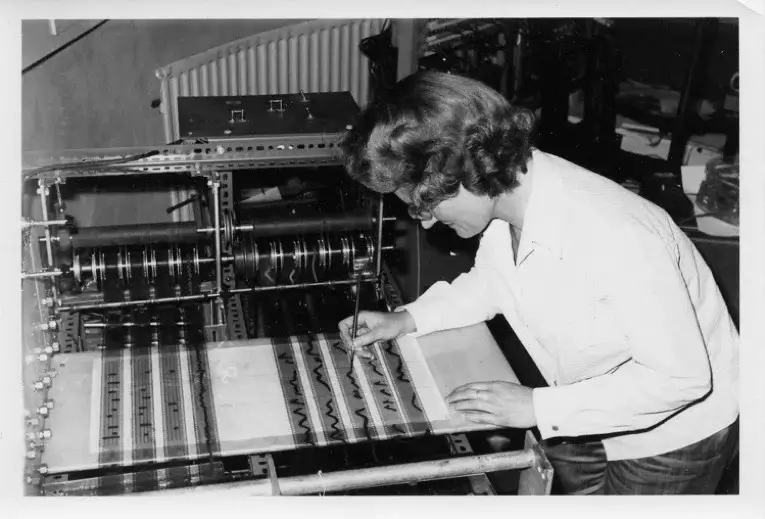
Unfortunately Oramics had a very short run, although it was used in the 1960s in several films and plays, its practical use was superseded once voltage control technology was introduced in synthesizers, but it did inspire later developments in software.
Daphne Oram also left writings on electronic music and studio techniques, her major work An Individual Note of Music, Sound and electronics is a very special and rare book, you could say it is like an electronics manual from a philosophical-mystical perspective.
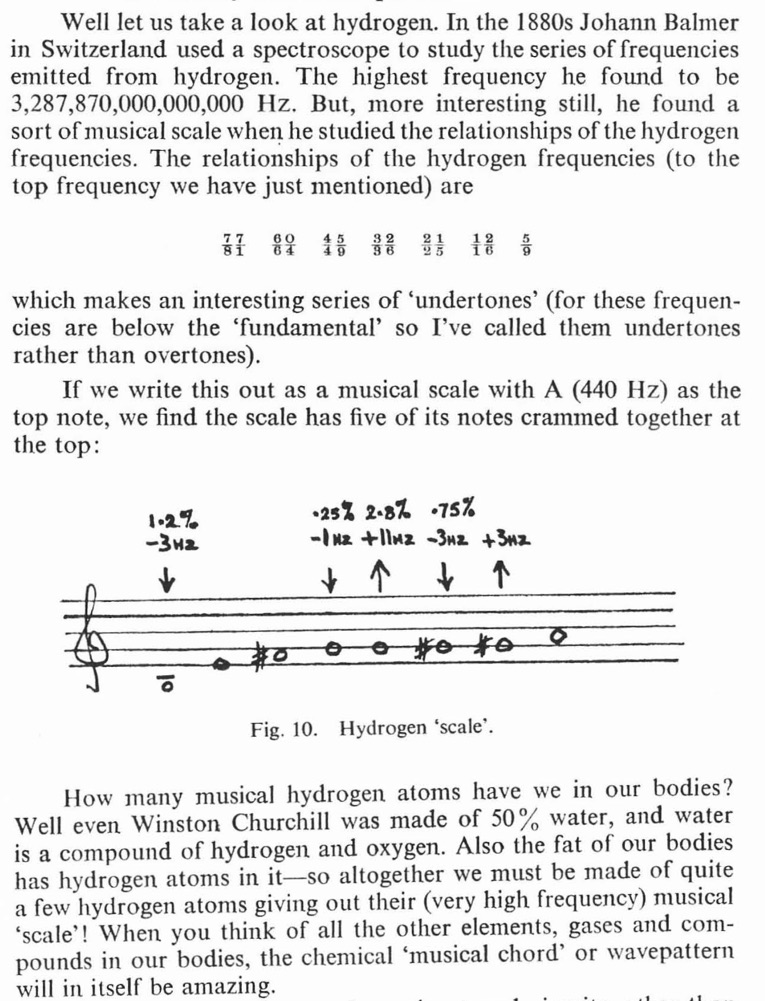
The idea of a «graphic music» system obsessed Oram throughout his life. Despite his great contributions, he was anonymous during his lifetime. His legacy began to come to light after his death in 2003.
His perspective of electronic music, not as something mechanical and soulless, but as something potentially organic and imperfect (like any other music), is very humanistic and democratic. Oramics' gestural interface allowed anyone to compose music in an experimental and intuitive way.. His work, although it sounds naïve from today's perspective, invites us to flee from cynicism and pragmatism, encouraging us to create creative and accessible tools.
Bibliography:
- Crab S. Oramics’ Daphne Oram. UK, 1959.
- Holzer D. (2010). A brief history of optical synthesis.
- Reza S. (2009). The feminine side of sound.
- Wilson G. (2003). Daphne Oram, the unsung pioneer of techno.
- Williams H. (2017). The woman who could ‘draw’ music.