← Blog from Guindo Design, Strategic Digital Product Design
Beginnings of visual programming in education
The biggest barrier to entry to learning programming, mathematics and even simple arithmetic, is their high level of abstraction, and the difficulty of finding direct application in the real world as new concepts are acquired. You probably studied matrices and vectors in high school, but let's face it, if you haven't applied them since then, you probably only remember a vague melody. Immediate application of knowledge is vital for it to stick. Memorisation is of little use if it is not put into practice and, most importantly, if you cannot visualise its results.
If the visual programming transformed engineering, design and automation, its impact on education, and especially on the teaching of computational logic, has been even more profound and, in my view, far more magical.
Giving orders to turtles
If you have grey hair, it is very likely that you are familiar with Logo, a simple programming language designed for children to take their first steps in programming. It became popular in Spain in the mid-1980s, but it was created in the 1960s by Seymour Papert and his team at MIT. Although text was used to interact with the program, its main innovation was the “turtle”, a visual metaphor to illustrate a cursor that responded to commands to draw shapes on the screen.
Papert's turtle was, in its early days, a physical robot that drew on paper in response to teletype commands - imagine the excitement of those children when they saw a robot come to life with their commands! But in the early 1970s, it morphed into the triangular figure floating on the screen that most of us remember. The commands were simple and straightforward:
FORWARD 10I would move it forward 10 steps.RIGHT 90I would turn it 90 degrees to the right.- …
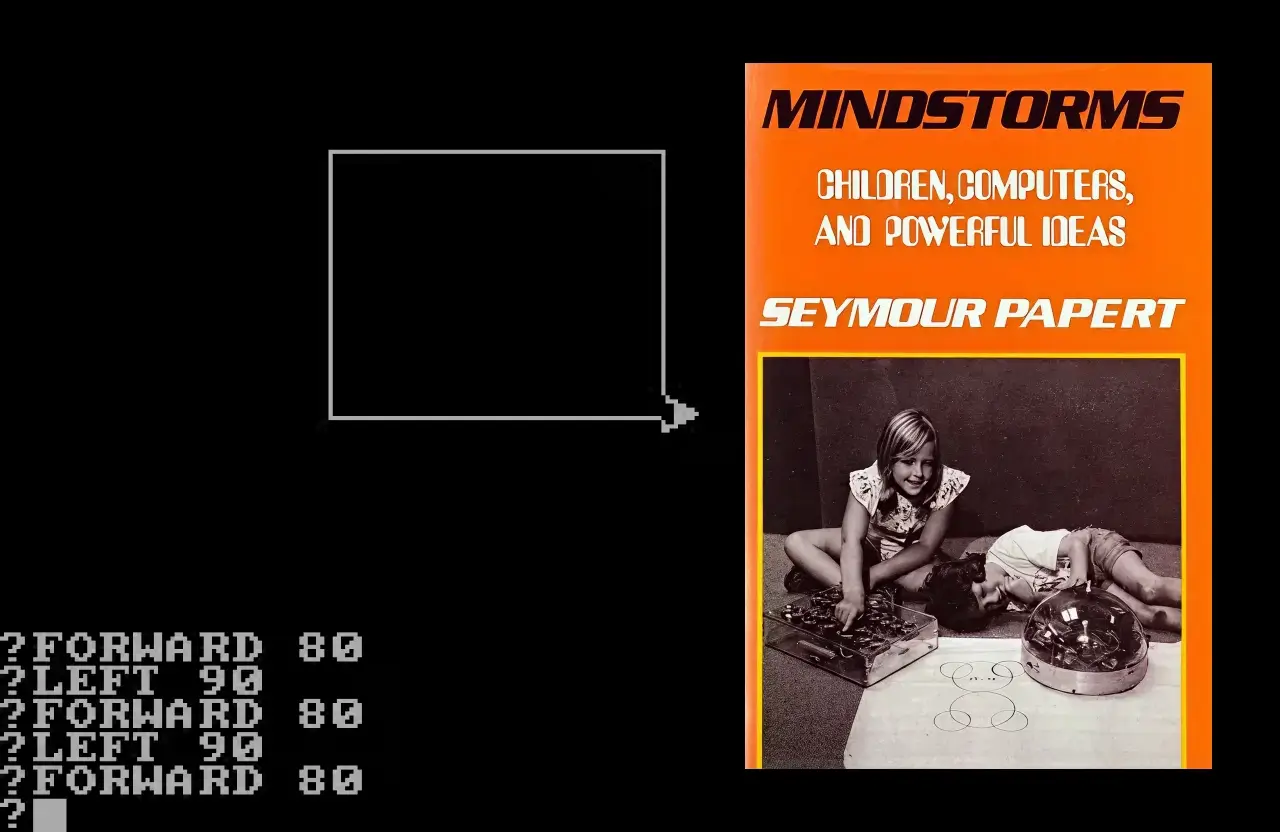
By combining these simple instructions, we could draw complex geometric figures and, almost without realising it, we were learning the basics of procedural programming.
Digital transitional objects
From the time we are babies we use transitional objects, such as a blanket or a cuddly toy, to feel safe, to start building our identity and to learn to interact with the world around us. These objects give us a sense of control, arouse emotions and, of course, are used for play. When the first digital “transitional objects” appear, such as Logo's turtle, they are often just as cuddly and remind us of our childhood toys.
When we interacted with it, we were not just dealing with software; we projected ourselves into it. In the first Logo classes, I remember that we stood up, walked around and turned our own bodies to better understand how the turtle should move. This interface was not just an object, but a way to connect our inner world with the “micro-world” of the computer. Just as we do with a character in a video game, we projected a part of ourselves onto this triangular figure.
My personal experience with Logo was, without a doubt, my first «hello world»memorable. For the first time, we could see our instructions instantly transformed into visible action. I fondly remember hanging out in the computer room at break time with the rest of my geeky friends, instead of playing football, animating characters with Logo.
Colour blocks and assembly programming
As personal computers became commonplace in schools in the 1980s, Logo skyrocketed in popularity. However, in the early 1990s its use began to decline, as, like many languages, it required learning complex punctuation rules (where to put brackets, commas or colons), which distracted children from what was really important: learning programming ideas and logic.
Mitchel Resnick (MIT) and Brian Silverman, then scientific director of Logo Computer Systems Inc., they realised the problem. They had been working with LEGO for the previous decade, so it was natural for them to use the metaphor of building blocks: if children could build houses and castles with physical bricks, why not build programs with graphical blocks? This eliminated the headache of complex syntax. The prototype was called LogoBlocks (1995-96), and was very attractive to both children and educators.
Computer clubs for children
Before Scratch even began to take shape, the MIT Media Lab had already launched one of the most influential educational initiatives in the history of creative learning: The Computer Clubhouse. Founded in 1993 by Mitchel Resnick and Natalie Rusk, This model offered young people from under-resourced communities a safe space to explore technology creatively, accompanied by mentors and surrounded by modern tools, from design software to robotics kits. Its philosophy was not to “teach computer science”, but to allow each young person to express themselves by creating meaningful personal projects. With the support of the Intel Foundation, The initiative expanded rapidly, becoming a The Clubhouse Network, present in dozens of countries. This global ecosystem demonstrated that when young people have access to a trusted environment and accessible tools, they develop creativity, technical skills and a sense of belonging. Years later, these spaces would be key to detecting real needs, inspiring new ideas and serving as a living laboratory in which Scratch would be born.
In 2002, a visit by the team to the first Computer Clubhouses in India confirmed the urgency for new tools. The young people wanted to create games, animations and interactive stories, but the available languages were inaccessible to them.
In the early 2000s, several groups were developing graphic languages for children, such as Alice y AgentSheets, but the MIT research group was particularly inspired by Squeak Etoys from Alan Kay, due to its characteristic of “liveness”children could modify the code while the programme was running and see the results immediately, as well as sharing and exploring other people's projects. After a key meeting with Kay in 2001, the team decided to develop a new, broader and more accessible language, taking ideas from Etoys and keeping the block philosophy.
Remixing and sharing
The design of Scratch was built from direct observation. Through playtests continuous in schools, libraries, museums and Clubhouses, The team saw how the young people brought their projects to life by integrating their own images, music, dances and invented characters. This constant dialogue between the creators and the tool consolidated a key idea: programming languages not only teach logic, but also shape a way of thinking, expressing oneself and relating to technology.
With that vision, Scratch was also conceived as a social space. Its name, taken from the technique of scratching DJs (mixing and remixing music), and inspired by the emerging culture of platforms such as Flickr, underlines its philosophy of community. In 2005, the Scratch online community was born, where sharing, commenting, remixing and learning from each other became a fundamental part of the creative process. This safe and collaborative ecosystem brought the community spirit of the Clubhouses to the digital world.
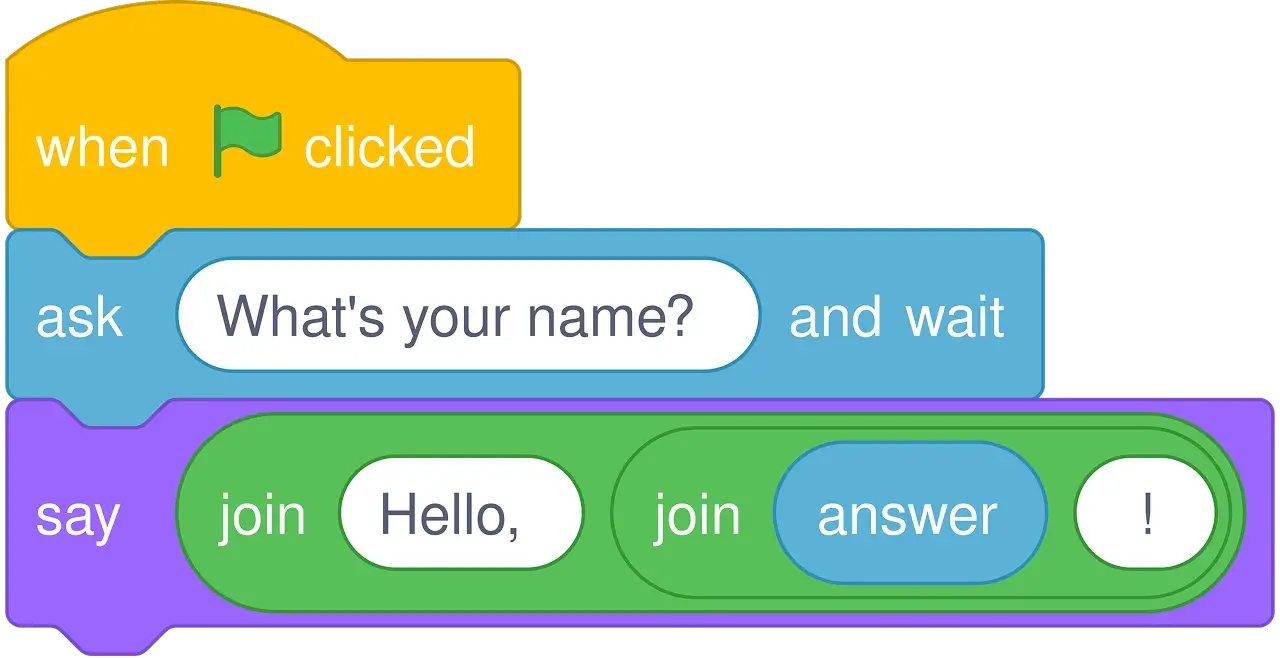
Since then, Scratch has continued to evolve, but its most profound impact is perhaps not in the tool itself, but in the sensibility it helped shape. The generation that grew up creating animations, music loops and games with colour blocks is, years later, the generation that has driven the current wave of visual programming tools. The culture of vibecoding, with its emphasis on testing, sensing and refining in real time, is a direct heir to that approach: programming that is more intuitive, more aesthetic, more playful and, above all, more human. Like Logo's turtle or Scratch's blocks, many of these tools function as digital transitional objects, allowing for direct experimentation and projection of ideas, keeping the playful dimension of learning alive.